Saturday, June 26, 2010

38th Indiana Fiddler's Gathering

The glow things were reasonably priced.
People were jamming until 4 a.m. by our tent but the kids slept through it like the champion sleepers they are. And then I had this great breakfast burrito. There were lots of trees around us.

We were on the Tippecanoe battlefield, which I think had something to do with Indians. I'm about to remind myself on Wikipedia.
My friend Dean, picking until 5, back at it at 9.
Kids were mainly into running with other kids, but sometimes they sat down.

And then we were tired. A graduate of Indiana University, it is my sworn duty to disparage West Lafayette and everything related to it, especially for its supposed ugliness. But I have to say, the drive there was so nice. There are gentle hills that have rivers fitted between them with names like "The Tippecanoe," and the rivers move with a purpose that almost suggests a consciousness on their part that they are rivers and that there is a power in that. The rivers where I live don't behave that way. They need to be reminded which way is downstream sometimes, like they would rather seep outward, creep up their soaked banks, or just wait until August to dry out completely.

Posted by Picasa

new panda bear

Tuesday, June 15, 2010

First day of summer

One of Jim Harrison's handsomer poses (on the right).

So, it's the first day of my "short" 8-week summer and it felt right to start it with a Jim Harrison novel, True North. I like it for its trappings. Lots of its sentences contain the words "Lake Superior" and also many names of upper peninsula towns that I know from driving around those parts. The dim-but-sensitive narrator is always naming the fishing streams he's driving to, too, and I don't really fish until I read a book that has fishing in it so maybe this summer I will. All of the ideas this book tries to carry along with it tend to just fall out of its pockets, but I'm really enjoying the whole "I did this, and then I drove here" looseness of it all.

The book has relaxed me pretty well, actually, because it is stressful, starting a long summer vacation. You, or I, feel like it has to be planned out and ordered to find the perfect balance between things that should be done and the things that you want to do. But after sitting around reading most of the day I'm okay with the possibility that, come mid-August and school, I'll be fine if my summer is just a bunch of loose threads, pointless drives, half-hearted projects.

Sunday, June 06, 2010

a lot of pictures

The chicks are gone now, off to chicken school. I was a little sad to see them go but they were not sentimental at all about it. I don' t think they even recognize me.
The Catalpa is the most useless and annoying tree ever made, but June made these shoes out of its leaves so now I have mixed feelings about it.

Finally, I think the Globe Thistle is going to bloom this year.

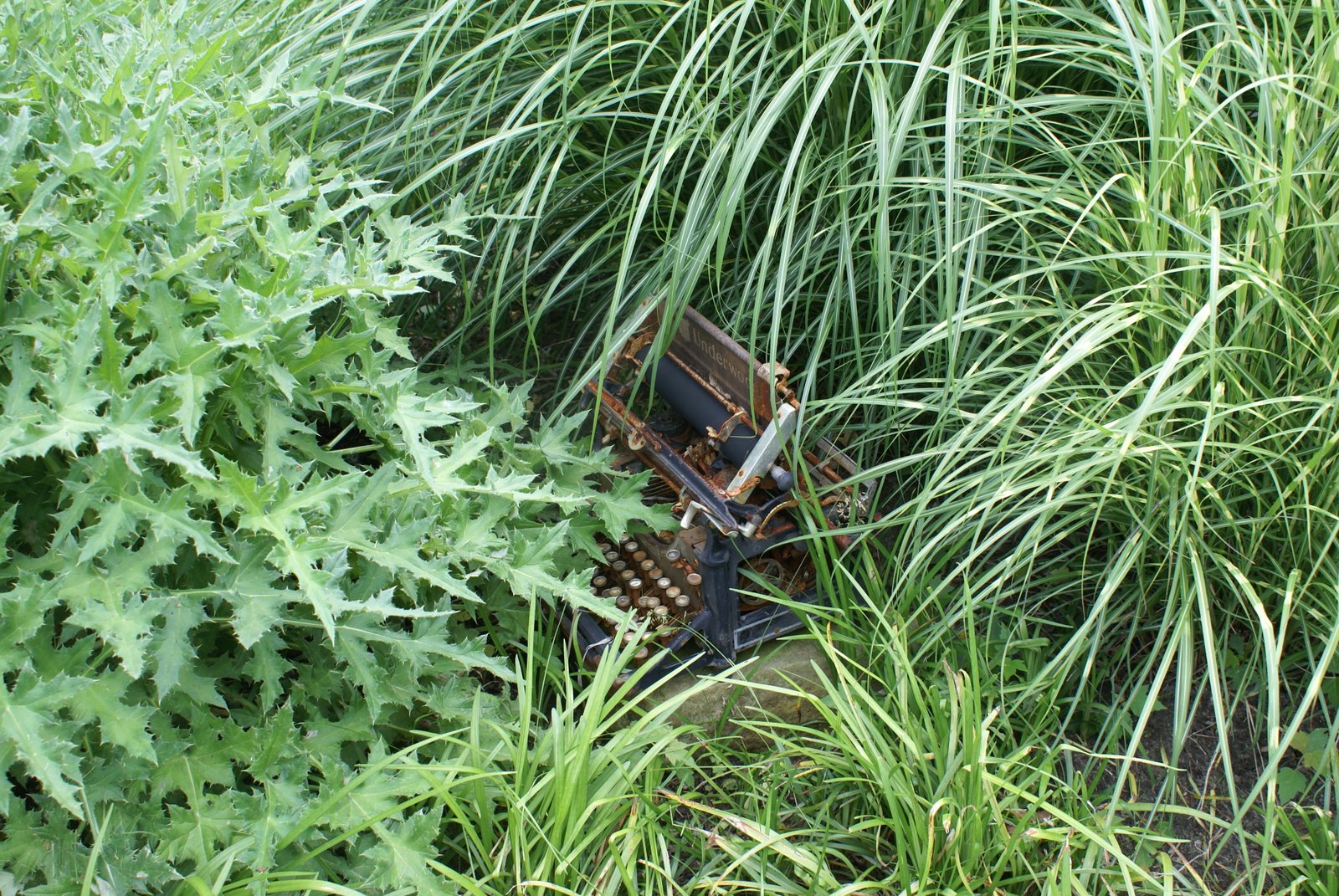
The Garden Typewriter is rusting.

I can't believe how far ahead everything is this summer, like four weeks it feels like. The plants are going to get bored by the end of July, wondering what to do next.
Posted by Picasa

Wednesday, June 02, 2010

Often when you are wasting your life on the internet, you come across things other people do that you wish you could do. A prior generation would be inspired to try to do these things. Now, though, we just put links to them on our blogs or tumblrs. I don't know what it is about this woman's style that I like. The colors, mainly, I guess. But the sketchbooks on her site are the kinds of things that make me want to draw for an hour and then quit, disappointed. Her site.

Monday, May 31, 2010


One of the daily battles for chicken supremacy in our bathtub this Monday evening.

Sunday, May 30, 2010

Okay, then. Just finished Middlemarch, sitting here on the porch at the lake with the breeze and the sound of the waves. So lucky.

So I probably like Mill on the Floss a little better than this one, but it's close. There are some chapters in Middlemarch that affect me in ways I just don't know how to write about. The scene where Ladislaw walks to Dorothea's church and sits through the service simply hoping to make eye contact with her and fails even to get that, the resigned reconciliation of Lydgate and Rosamond, and all of the scenes depicting various species of provincial ignorance. It's all too much.

We were listening to the Wind in the Willows audiobook on the drive up here and I was taken at how much it reads like a George Eliot kids' book. Grumpy animals pottering about, grand authorial asides, and a diction that, though meant for children, sees no reason not to use words like "paroxysm" with regularity. These days, the kids section at any local Borders makes it look as though children's literature is full of options, but it's all so bad. I read what June brings home from book fairs and it seems like something designed so that the kids might one day aspire, if they keep reading all their Magic Treehouse books, maybe, to manage Harry Potter. I think I've decided to only read stuff with the kids that is over their heads and fun and serious. If you are not disoriented, your reading list is not challenging enough. That will be my motto.

But now I might leave the 19th century for my next books, but gently. Re-reading Wallace Stegner, for example. Angle of Repose or Crossing to Safety.


You finished your book, now throw me a stick.

Thursday, May 27, 2010

If I had a building


Here's a distant shot of the historic freight depot that many think is about to be torn down this weekend. "Historic" is a relative term, I guess. I mean, I don't know if any famous freight ever passed through here or if Kerouac ever rode by it with Neal Cassady in a boxcar, but the fact is that, compared to a lot of what we have left in this town, this is our history. It's near a downtown that keeps threatening to become a destination, is right across from two of our most beautiful urban parks, and is about 100 yards from our ever-expanding greenway and a skate park that is so cool I can't stand the fact that I never got into skating and only donned the haircuts for a few years.

It may go down, though, because the current owner doesn't, publicly, at least, appear interested in entering a dialogue about possible uses. But if it goes down, I hope it's not without some noise. If this is the kind of thing you care about, join the Facebook group or go to the web site and sign the petition. It's a pretty non-confrontational, responsible group of people running the group--friends of mine, radicals only in the sense that they see value conservation.

I see an old building like this and can only think of the businesses I would run there. I mean, look at its length. What would you do there? It looks to me like nice place for a family restaurant and brewery. Maybe some cool apartments or studios running along the back there. Great land for some kind of community gardening (um, unless it's a brownfield). Maybe an indoor skate park so that in the winter the skaters I teach don't have to be so glum all the time.

Anyway, do consider contributing to the noise that just might make a difference here. It would be a real waste of potential to turn this old place into one more corner of rubble. We have enough of those.

Cool apartment. I like all their stuff, the way they just have it there, in their place, and the casual way they sit there in the middle of it, with the sincerest form of feigned indifference. I wish I could feign my indifference like this.

Unhappy Hipsters would have something snarky to say about this picture, but (a) their credibility is damaged by the odd definition of "hipster" that they seem to be applying, and (b) they probably live in a dump. And (c) snark is the lowest form of internet speech.

Monday, May 24, 2010

Monday, May 17, 2010

assignment


Earlier this school year, one of my students, Nabia, schooled her class, myself included, in the possibilities of an often overlooked program called Windows Movie-maker. It's another one of those programs that makes me think "I'm sure there's a much better form of this for Macs," but she showed us that it's still cool enough to play around with and make some great movies.

Anyway, I copied Nabia's idea and assigned it as an option for one of my classes, a class that is based on independent reading, to make trailers for one of the books they read that semester. This video here is a sample I made for a fun read called The Dart League King.

It represents about three hours of time, and could use another hour. The inter-titles could be written more succinctly and the timing is off, but still, I like it, and I'm excited to see what students come up with for their books if they choose this option.

In the back of my mind, I'm a little bothered by one problem or blind spot this trailer approach has--it's emphasis on selling the plot of a book rather than its style and voice. There is nothing "wrong" with reading primarily for plot, but as a teacher, I feel like it's partly my responsibility to interest people in caring less about "what happens" and more about enjoying the "how it's told" part. This is complicated, though, because it's a mystery to me, most of the time. I don't know where to start when explaining why I love The Savage Detectives, a long book where nothing happens, or the Laura Ingalls-Wilder book The Long Winter other than to say that when I read them out loud, it feels good. Maybe some kind of read-aloud contest between literary and popular fiction might allow a class to make some observations and a dialogue.

Speaking of The Long Winter, which we are shoveling through a chapter or two a night . . . Birk heard a weather report with a lot of rain in it this morning and said "Dad, it's The Long Thunderstorm, get it?" One of his rare non-Scooby Doo or Andy Griffith Show allusions.

Monday, May 03, 2010

Damon, Naomi, and Dean
Drove to school and then drove right back this morning because I could tell that I was about to have a re-match with the stomach flu I thought I beat this weekend. So I have just a little bit of time before I'm incapacitated and have to get a few things done, some grading, some ideas about how to set up my AP students before the big test on Thursday (could be one of my best classes, I'm starting to think), but Pitchfork has this big article about Galaxie 500, like really long for the internet, and what am I supposed to do, not read it?

Their records feel like not soundtracks but actual emotional documents of my life back when they came out. And the more time passes, the greater they sound to me, and I don't think it's just nostalgia that is doing that. I wonder if I am running out of the ability to have new bands or whatever affect me like Galaxie 500 did and still does, because it doesn't happen very often anymore. It's like my heart is spoken for.

Sunday, April 25, 2010

Thursday, April 22, 2010

Just spent a long two weeks or so re-reading Dubliners, of all things. How does that take me two weeks? The book is so tiny it fits in your back pocket with room to spare for a copy of Lunch Poems, but still, I just couldn't finish the thing off.

It all started when I picked it up and read "The Dead" and I suddenly remembered how great that story is. I think I like any story that includes people shaking rain off of umbrellas as they climb creaking wooden stairs, but this reading really got me for reasons beyond overheated and smokey coziness of the rooms it takes place in. That end, I think it's pretty beautiful and sad and I don't think anyone should disagree with me on that.

But so I took my experience with "The Dead" as reason enough to re-read the whole collection, and . . . man, it just didn't happen for me. The stories almost feel dated now, much more so than people who modeled themselves on this book, like, say, Hemingway's short stories, which only get better with time and I'm not just saying that because I'm a dude, because I am anything but a dude's dude. I'm saying it because Hemingway, young Hemingway, short story and parts of Farewell to Arms Hemingway, is about as good as we get. So I was surprised at this time through Dubliners. It wasn't anything like what happens when I re-read "The Three Day Blow" or "The End of Something" or this one where about him and Hadley skiing somewhere in Europe.

And I doodled that picture of Joyce at school one day last week while I was trying to lesson plan.

Wednesday, April 14, 2010

Really charming article in the New York Times yesterday about a father and daughter who read out loud together, every night, from some young age until she went away to college. Every night! She would be out with friends on a weekend and she'd be like "oh, we have to stop by my house before midnight so I can read with my dad." Totally worth a look if you have a son, daughter, or parent.

I will admit that this story made me cry. Or no, tear up a little. This happens more frequently ever since I became a parent. Before, I only used to tear up when dogs died--both fictional and non--and during that scene in The Sound of Music when the dad comes in singing "Edelweiss" and all the kids are like "dang, dad's singing."

Monday, April 05, 2010

Tony Hoagland is pretty funny and that is enough for me to like a lot of his poems but he is also smart and has a great ability to write about poetry in a way that makes me think "yes, I agree." I had that reaction when I read this thing he wrote about Dean Young I wish I could find on the internet and I'm having it all the time now when I dip into his essay collection Real Sofistikashun that I would not have found had Joseph not pointed out to me that there were books below my eye level when we were at Hyde Bros. the other day.

There are a few varieties of the "yes, I agree" response that you can have when you read. One of the good ones is where someone has said something that you have consciously thought in the past but had thought you were the only one. And reading this person makes you feel understood and less lonely for a few minutes, even if you didn't know that you were lonely.

Another good kind is where someone says something that you didn't even know you had felt it until you read him saying it. His or her words cause a secret panel to melt inside of you and it reveals some unrecognized feeling that had been there all along. This happens a lot, if you read a lot, and it is one of the best things that can happen to you. A long time ago this happened to me a bunch when I read Richard Ford's Independence Day. Something about Frank Bascombe and how he was always "seeing around" his feelings. Relating to him should depress me but it doesn't.

An example of the former variety happened as I read one of Hoagland's essays a few days ago. He's describing surrealist poetry:
In the Surrealist aesthetic, imagery has virtue to the extent that it exhibits freedom, and art is "reliable" to the extent that it trusts in the revelation of process. The poem is an action, not an object, and its architecture is a series of moment to moment jolts and explosions.
I have thought, like, exactly that same thing for a long time. It works for things other than just surrealist poetry, too, I guess. That idea of the poem being an action, an enactment, is what gets me, and let's me read differently. The surrealist poem is less an object with a rhetorical purpose than a document of a life lived in a certain way. You could argue much contemporary poetry is that way, but I might argue that this modern tendency owes itself to Breton and the surrealists.

Anyway, writing about this makes me think about one of my favorite poems from the last Beloit Poetry Journal. I hope it's one Dawn voted for. I am going to steal it, I guess. If it's not okay, she will let me know.

Old Men

Your carnation-white flesh
Lives off scrawny birds
And thereby catches fire

You old men, sing slower
In the shifting wind
And let the sun crumble
Between your fingers

The blue-feathered sleep
Has the teeth of death
And the voice of lime
This is already a long post, so I will let "Old men" speak, or not, for itself. But it's beautiful whether or not.

Sunday, April 04, 2010

Coming back to Eliot after reading the new John McPhee book for a couple of days has me lost again. Thank you, Internet, for this great map. I can't make any sense out of it, either, but it's reassuring somehow.

Saturday, April 03, 2010

In the interest of taking credit for every single one of my kids' accomplishments, I can't help but note the influence of Tu Fu, whom we have been reading in Kenneth Rexroth's 100 Poems from the Chinese, on her recent writing. Here is Tu Fu:

Rain

Roads not yet glistening, rain slight,

Broken clouds darken after thinning away.
Where they drift, purple cliffs blacken.
And beyond -- white birds blaze in flight.

Sounds of cold-river rain grown familiar,
Autumn sun casts moist shadows. Below
Our brushwood gate, out to dry at the village
Mill: hulled rice, half-wet and fragrant

And here is one of June's, from the "poem book" she has been typing into the computer lately. It's nice:

The breeze and the wind brushed through my
hear as I fly a red kite.
The fall air is cold but I’m worm
in side.

I think June's compares well, considering that Tu Fu had a 1000+ year head start.

Wednesday, March 31, 2010

good luck with this one . . .

Watanabe, Naoko, and Midori

Just read that a movie version of Murakami's Norwegian Wood is being made, to be released in Japan this December. This makes as little sense to me as making The Road, or maybe as little as turning any novel into a movie. Sarah Dessen or Judy (Julie?) Picoult books do make sense, I think, as movies--so much sense that they could probably skip the book stage and go straight to the theater (not hatin', just sayin').

But Murakami? I know people are kind of divided on his value as a writer, but I've always really liked his detached style and the way it makes the mild absurdities of his stories seem almost normal. It's nothing like the way Marquez will do it, spinning these baroque-ly unreal settings and pretending that they are a part of the normal universe while still kind of winking at the reader "isn't this all just so gorgeous?!" I like Marquez; he can just overwhelm me sometimes.

Murakami is different, though. With him, you'll read about a man standing in a well for hours on end or a logo for a whiskey that eats stray cats and you have to decide for yourself just how weird it is. It will not feel that weird at the time, but it will later.

So, the main point here is that I don't see how any movie can achieve this effect without using a lot of voice-over straight from the novel. You can tell from the still picture above that the director probably told the Watanabe actor to use the "thousand-yard-stare" to express the floating wonder he carries around. That might get old. Maybe the best thing about the movie version is that it will get me to re-read a book I liked ten years ago and still remember fondly.

Sunday, March 28, 2010

It's raining so it's perfect for Middlemarch, which lately is starting to feel like a joyless Northanger Abbey. The first few sentences in of this book are always confusing for me as I have to pose questions to myself like "who is Mrs. Bulstrode's niece?" and "have I met any of these relations of Mr. Farebrother's before?" After a re-read sentence or two, I either answer a few of them them or push on with my slightly tempered bafflement intact.

I'm reading this one slowly, but one part I keep remembering from the Ashbery article I read a few days ago is how he read poetry quickly and prose slowly, with more consideration, and I think I do that too, so that is one way I am like a famous poet.

Today, there was some action, though, as Dr. Lydgate's cruel and thoughtless courtship of Rosamond suddenly exceeds his control, and, in a moment of surprise intimacy, he ends up engaged. A lovely line in there describes how "flirtation was shaken into love" or something like that. This book might seem, to the outward eye, as slow-moving at times but what I love is the way Eliot documents the private movements--the dramatic shifts of public regard in general and also the individual expectations and disappointments--all these things happening out of sight but revealed with Eliot's careful voice.

That word, "expectation," too--that's one of my favorite expressions right now. Men here have to be careful not to hold eye contact too long with a woman or risk there arising "an expectation" between them that they will have to answer for. Every step here is so fraught with social dangers.